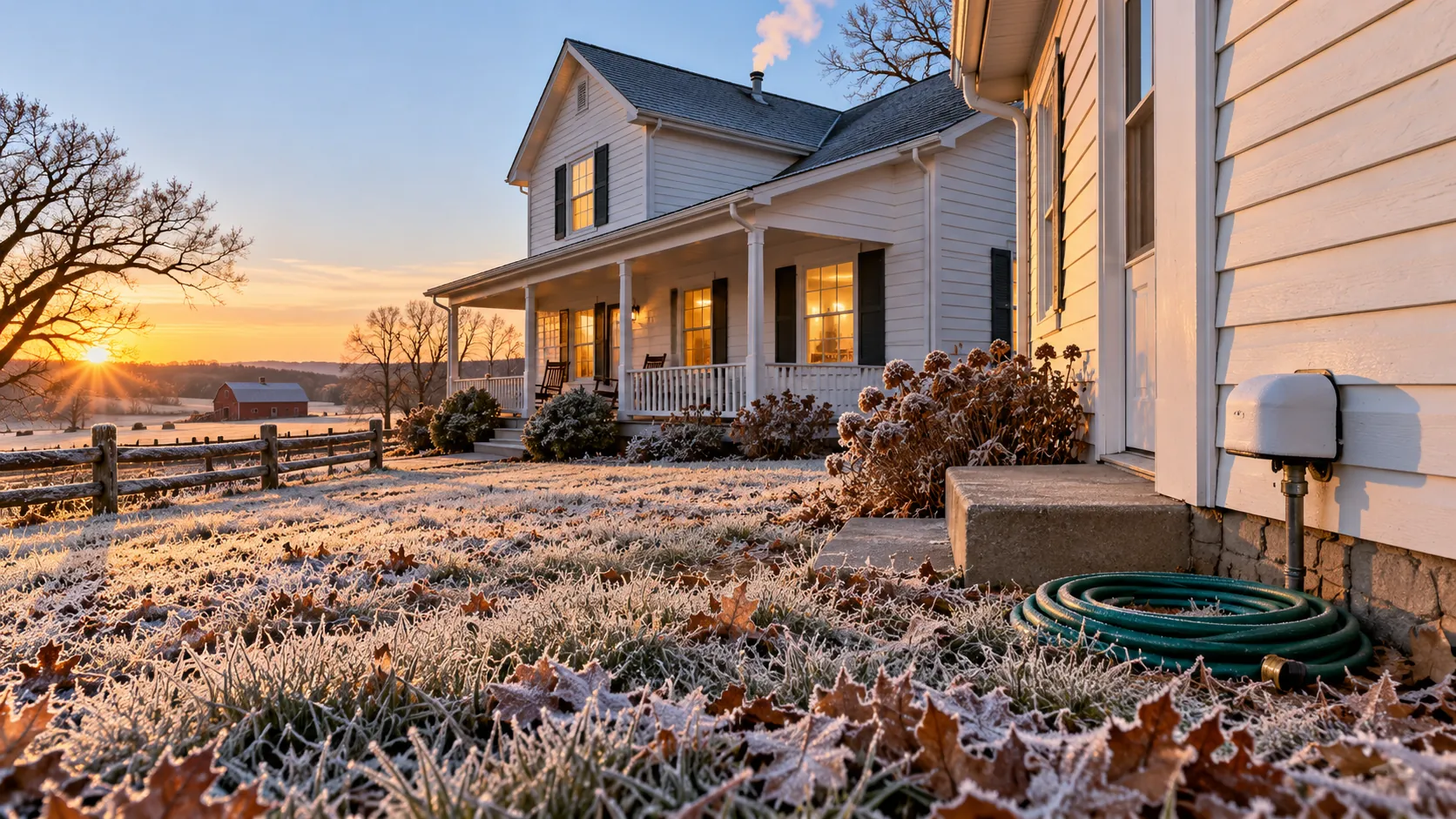
It’s 6:10 on a January morning. The porch thermometer says 4 degrees. The coffee maker is gurgling along, and the kitchen faucet gives you one cough of air and then nothing.
Somewhere inside the wall, a pipe has turned to ice.
If you’re lucky, it thaws slow and holds. If you’re not, you find out where it split when the water comes back. Usually through the ceiling.
That’s the strange math of winter. Most of what prevents freeze damage is cheap and a little boring: a foam cover on the outside faucet, a thermostat that stays put, a cabinet door left open on the coldest night. The bill when it goes wrong isn’t boring at all. State Farm reported that its frozen-pipe claims from January 2024 through June 2025 averaged more than $30,000. In the chart released with those numbers, Missouri ranked seventh among the states, at about $23.3 million paid.
So before the first real cold snap, here’s what to check around the house, the barn, and the shop. And how to find out what your home insurance expects of you when the temperature drops.
What is this winter supposed to look like?
Nobody can promise you the date of the first ice storm. Not NOAA, and not your uncle’s bad knee either.
NOAA released its 2026–27 winter outlook on October 15, and the headline is El Niño. A strong one. The Climate Prediction Center says a strong-to-very-strong El Niño is likely to last through January–March 2027. For Missouri, NOAA’s maps lean warmer than normal for December through February. The precipitation signal is weak, and the outlook doesn’t forecast snowfall totals.
Warmer than normal is still winter in Linn County. It only tilts the odds, and one bad week can do the damage. The Missouri Climate Center called January 14, 2024 one of the coldest days on record statewide, and that stretch came with frozen pipes, power outages, and stressed livestock. January 2025 was the coldest January since 2014. And if you were here for the February 2011 blizzard, you remember it. The National Weather Service recorded 20 inches of snow in Brookfield.
This winter, the National Weather Service will also add “Particularly Dangerous Situation” wording to some blizzard and ice storm warnings, for storms of historic severity. If you hear those words on the radio, take them seriously.
The first hard freeze, meanwhile, is basically here. The University of Missouri’s freeze records for Brookfield, the closest station in Linn County, put the median first 28-degree night on October 28. Nine years in 10, it arrives by November 10. Missouri’s Winter Weather Preparedness Week runs November 2–6. Consider this your head start.
Winter temperatures worth knowing
Five numbers to keep near the thermostat this season
- 68°FIndoor heat for older adultsThe National Institute on Aging recommends at least 68°F. A house kept at 60 to 65°F can lead to hypothermia in older adults.
- 55°FLowest setting when you’re awayThe American Red Cross and IBHS say to leave the heat on, no lower than 55°F.
- 32°FWater freezesDisconnect hoses and shut off outdoor faucets before the first night at this mark.
- 28°FHard freezeIn Brookfield, half of years see the first one by October 28, and 9 in 10 by November 10.
- 20°FPipes in unheated spaces at serious riskUniversity of Illinois research set a 20°F alert for uninsulated pipes in unheated attics. Pipes near cold air leaks can freeze sooner.
Where do pipes freeze first?
Water lines freeze where the heat doesn’t reach. Crawl spaces, attics, garages, and outside walls. The cabinet under the kitchen sink, if the sink sits on an outside wall. And the outdoor faucet, every time. IBHS points out that homes built before 2010 typically don’t have frost-proof outdoor faucets.
The American Red Cross and IBHS recommend a short list before the cold settles in:
- Outdoor faucets: Disconnect, drain, and store the hoses. Close the inside valve that feeds each outdoor faucet, then leave the outside faucet open so it can drain.
- Exposed pipes: Insulate pipes in the attic, basement, and crawl space. Pipe sleeves or UL-listed heat tape can help. Cover vented crawl spaces.
- The coldest nights: Open kitchen and bathroom cabinet doors so warm air reaches the pipes, and move cleaning products out of children’s reach. Let cold water drip from faucets served by exposed pipes.
- The thermostat: Keep it at the same setting day and night. If you’ll be away, leave the heat on, no lower than 55°F.
- The garage: Keep the door closed if water lines run through it.
One more, and it might matter most. Find your main water shutoff now. In daylight, with a flashlight you don’t need yet. Not at 2 a.m. in January with water running down the basement stairs.
If a pipe freezes anyway
If you turn on a faucet and only a trickle comes out, suspect a frozen pipe. The Red Cross says to keep that faucet open and warm the frozen section with an electric heating pad, a hair dryer, a space heater kept away from anything that can burn, or towels soaked in hot water. Never use a blowtorch, a kerosene or propane heater, a charcoal stove, or any other open flame. If you can’t find or reach the frozen spot, call a licensed plumber. Check your other faucets too.
If a pipe has already burst, shut off the water supply first, then call a plumber. Photograph the damage before you make temporary repairs, keep your receipts, and contact your insurer or agent promptly. Our claims and policy service page can help you plan who to call.
What does your homeowners policy say about freezing?
Here’s the good news first. In its January 2026 winter-weather guidance, the Missouri Department of Commerce and Insurance said a typical homeowners policy covers repairing frozen pipes and the damage they cause.
Now the fine print. DCI also said exceptions can apply when a home is vacant or under construction, unless the owner used reasonable care to keep the heat on, or shut off the water and drained the system and appliances. The NAIC describes the same idea: policies generally expect you to keep a minimum temperature, or to shut off the water when the home is empty.
That’s the line about keeping the heat on. Your policy has its own wording. Ask your agent to show you where it is and what it asks of you.
While you’re on the phone, a few other winter questions are worth asking:
- Sump pump and sewer backup: Triple-I says a typical homeowners policy doesn’t cover water that backs up from a sewer or sump, and neither does flood insurance. Coverage is usually added as an endorsement or bought separately. Ask whether you have it.
- Food after a power outage: DCI says most policies include at least $500 for food lost in an ice-storm power outage, while some require an optional endorsement. Ask what yours includes and whether the deductible applies.
- Ice and snow on the roof: DCI says most policies cover collapse of an insured building from the weight of ice, sleet, or snow. Triple-I lists damage from ice dams among the water damage homeowners policies cover. Confirm how yours handles both.
- Trees: If an ice-heavy limb lands on the house, ask about removal. Triple-I says removal is generally covered up to about $500 to $1,000 when the tree hits an insured structure, and generally not when it falls without hitting anything.
- Melting snow and rising water: Water that seeps in from the ground as snow melts is a flood question, and flood takes its own policy. Missouri DCI says a new flood policy can take 30 days to take effect. The spring thaw is a bad time to start asking.
About those ice dams
An ice dam is the ridge of ice that builds along the edge of a roof. University of Missouri Extension explains how it happens: warm air leaks into the attic, melts the snow on the roof, and the water refreezes at the cold eaves. The ice backs up, and the water finds its way under the shingles.
The long-term fix is attic insulation, air sealing, and ventilation. The short-term fix is a roof rake, and MU Extension suggests leaving that job to professionals. Not you on a ladder in February.
Leaving the house empty this winter?
A trip to see the grandkids. A hospital stay. A month somewhere warmer. A rental house sitting between tenants. An empty house in a Missouri January is where frozen pipes do their worst work, because nobody’s there to hear the drip.
Triple-I says most homeowners policies have a vacancy clause that limits or excludes coverage after a home has been unoccupied for a stretch, typically 30 to 60 consecutive days. It recommends keeping a vacant home at 55°F or warmer, checking it weekly, and telling your insurer.
So before you go:
- Call your agent and ask what your policy says about vacancy and time away.
- Leave the heat on, no lower than 55°F.
- Ask a neighbor or family member to check inside the house, not just the mailbox.
- If the heat won’t stay on, ask about shutting off the water and draining the system.
Tell us before the trip. Not after the neighbor calls.
Keeping warm without starting a fire
Heating equipment causes about 11% of reported home fires, according to NFPA’s 2020–2024 figures, and 46% of those fires happen December through February. Space heaters and heating stoves are involved in about 30% of heating fires but 73% of the deaths.
The rules from NFPA, the U.S. Fire Administration, and the Missouri Division of Fire Safety are short:
- Keep anything that can burn, including furniture and drapes, at least 3 feet from any heat source.
- Plug space heaters directly into a wall outlet. No extension cords or power strips.
- Choose a heater with a tip-over safety switch.
- Turn portable heaters off when you leave the room or go to bed.
- Have the furnace, wood stove, and chimney inspected and cleaned every year. Never use the oven to heat the house.
- Test smoke and carbon monoxide alarms every month.
Added a wood stove, a pellet stove, or a standby generator this year? Tell your agent. It’s the kind of change your policy information should reflect.
The quiet danger
Carbon monoxide has no color and no smell. The CDC says more than 400 Americans die each year from unintentional carbon monoxide poisoning not linked to fires.
Put battery-operated or battery-backup CO detectors near every sleeping area. If the power goes out, run a generator only outdoors, more than 20 feet from windows, doors, and vents. Never in the house, the basement, or the garage, even with the door open.
In November and December 2023, six Missourians died of carbon monoxide poisoning in two incidents where generators were run inside homes, according to the Missouri Division of Fire Safety.
Twenty feet. Every time.
Check on the house down the road
Older adults can lose body heat fast. The National Institute on Aging recommends setting the heat to at least 68°F. Missouri SEMA reports that 38 Missourians died of hypothermia in 2024.
If you have an older neighbor, a widowed aunt, or a friend who “doesn’t like to run the furnace,” check on them during cold snaps. Missouri’s warming centers are listed at health.mo.gov/warmingcenters, or dial 211.
Heating bills can be part of the problem. Missouri’s Cold Weather Rule runs November 1 through March 31. During that time, utilities regulated by the Missouri Public Service Commission can’t disconnect heat-related gas or electric service when the National Weather Service forecast for the next 72 hours calls for temperatures below 32°F. If your power comes from a co-op or a city utility, or your heat comes from propane, ask your own provider what protections apply. Missouri’s LIHEAP energy assistance program can also help eligible households. Call 855-373-4636.
On the farm, keep the water open
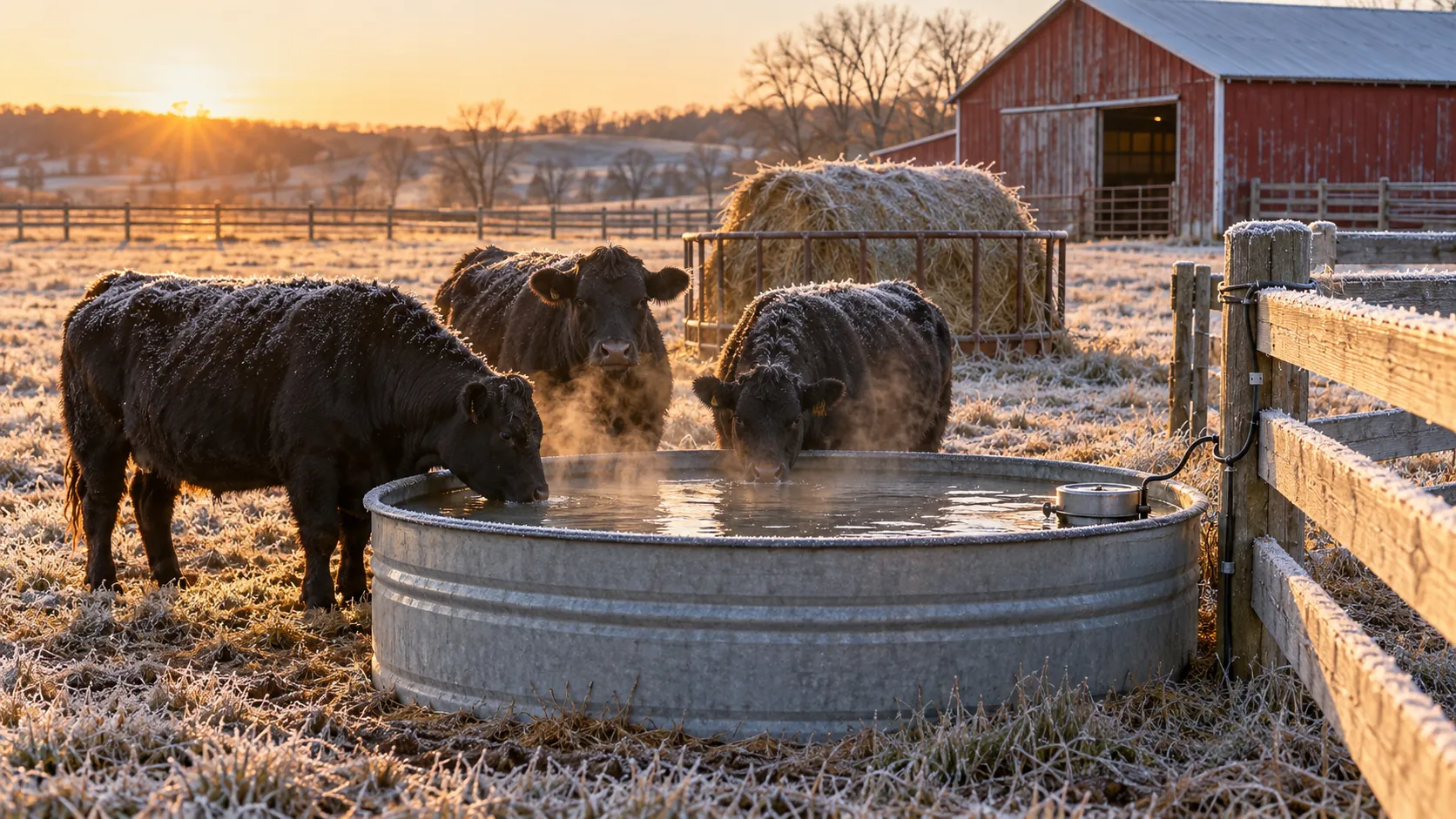
Cattle can handle a lot of cold. A frozen tank is another story.
University of Missouri Extension says cattle should drink about 1 gallon of water per 100 pounds of body weight a day in cold weather, and mature beef cattle can need up to 30 gallons. That’s a lot of ice to chop.
Cold costs feed, too. K-State Research and Extension lists the temperature where a cow in moderate body condition starts burning extra energy to stay warm:
- Dry, heavy winter coat: 18°F
- Dry winter coat: 32°F
- Wet coat or summer coat: 59°F
Below that line, a cow’s energy needs climb about 1% for every degree with a dry coat, and 2% with a wet one. By those numbers, a wet cow on a 35-degree day can need more extra energy than a dry, heavy-coated cow on a 10-degree night. Rain is hard on a herd. MU Extension recommends bedding, a place out of the wind, and extra feed when wind chills fall below 19°F.
The things that keep water open and calves warm can also start fires. South Dakota State University Extension calls heaters “a top fire hazard in barns.” Its barn checklist includes:
- Hang heat lamps securely with wire or chain, not twine, and use lamps with a guard around the bulb.
- Keep heaters and lamps away from straw and hay.
- Clean dust and cobwebs off heaters, lights, and outlets.
- Skip extension cords in the barn.
- Check tank-heater cords, keep them away from animals, and don’t let a heated tank run dry.
- Keep a fire extinguisher in the barn.
Then bring the farm questions to your agent:
- Are barns, shops, and livestock buildings listed correctly, along with what’s inside them?
- Is your livestock covered, and for which causes of loss? Ask specifically about losses in extreme cold. Don’t assume.
- How would the policy treat a frozen well pump, waterer, or water line to an outbuilding?
- If you added a generator, heaters, or a new livestock building this year, does the policy information show it?
Our harvest-season farm review has more questions about equipment, buildings, and stored grain, and you can see what we help with on the farm and ranch coverage page.
For local businesses: the pipes and the front step
A small business has two winter problems at once. The pipes inside and the sidewalk outside.
IBHS says burst pipes are the leading cause of winter-weather property damage for businesses. It recommends setting the thermostat to at least 55°F, making sure the inside of the building never drops below 40°F, and adding a temperature alert system. If you have fire sprinklers, the National Fire Sprinkler Association says water-filled sprinkler pipes must stay at 40°F or warmer. Watch vestibules, stairwells, unused rooms, and attics.
Outside, OSHA recommends clearing snow and ice from walkways and spreading deicer as quickly as possible after a storm. A customer’s fall on an icy step is a liability question, so ask how your business policy would respond. Ask, too, about business income coverage if a freeze or a power outage keeps the doors closed for a few days.
On the road
Missouri SEMA reports more than 3,370 crashes in snow, sleet, hail, or ice in 2024, with 819 injuries and 10 deaths. Before the first slick morning:
- Check road conditions on MoDOT’s Traveler Information Map or call 888-ASK-MODOT before you leave.
- Keep the gas tank at least half full. Stay at least four car lengths behind snowplows, and don’t pass them, as MoDOT’s winter driving tips advise.
- Pack a car kit: a blanket, extra clothes, water and snacks, jumper cables, flares, and a shovel with some sand for traction.
Then ask your agent one question. Which part of your auto policy responds if you slide into a ditch, and which part responds if an ice-loaded limb comes down on the truck in the driveway? They can be different coverages with different deductibles. Our deer collision guide explains comprehensive coverage and deductibles in more detail.
Start before the faucet coughs
Winter doesn’t send a renewal notice. It just shows up some night in December and starts testing things.
Buy the foam faucet cover. Find the water shutoff. Check the tank heater cord. Then call Black Insurance Group, LLC at (660) 376-4200 and ask about the line in your policy about keeping the heat on, or contact the agency here. We’re at 115 E Howell Ave in Marceline and serve customers throughout Missouri.
Call the office before sharing documents. Please don’t email policy numbers, claim details, or other sensitive information.
Do it while the faucet still works.
This article provides general insurance and safety information. Coverage, exclusions, deductibles, endorsements, eligibility, and available options vary by policy and insurer. Coverage cannot be bound, changed, cancelled, or guaranteed by email or through this website. Speak directly with a licensed agent. In an emergency, call 911.